


The 2025 Skillset: What Every Student Should Have Mastered
- 2025-12-22
- 3 Com
The world changes faster than ever before. By the time new technologies emerge, jobs change, and global issues arise, today’s children must be prepared not only for exams but also for life. If they want to succeed, they will need more than just textbooks; they will need the right skills that will be in demand in the future. Such skills will enable them to adapt, develop, and grow in a constantly changing world.
This blog lists the 10 most essential learning skills for future students that any student should have learned by 2025. It doesn’t matter whether the skill is critical thinking, effective communication, or getting used to technology. These skills are the foundation for students’ long-term success.
How These Skills Shape Your Future
The ability to acquire and practice essential life skills will greatly help high school students in their professional career development over time. Once equipped with these foundational skills, handling change, managing stress, and juggling multitasking in college will be a walk in the park. On top of that, self-reliance, for instance, financial freedom or knowing the basics of taxation, will not be that difficult if you are accompanied by strategic planning.
The process of equipping oneself to endure various kinds of college stress thus becomes much easier, thereby developing strong mental fortitude. These life skills for the future provide the resilience needed to solve life’s challenges efficiently. Eventually, life skills become indispensable because they enhance one’s professional abilities and serve as a foundation for becoming a successful, well-rounded person.
Discover the 10 most essential life skills that everyone should know before college to lead a bright, balanced, and successful life.
1. Critical Thinking and Problem-Solving
In today’s 21st-century world, learning and gaining knowledge have changed from mere fact memorizing to critical and analytical thinking. Students must research and scrutinize the provided information, question assumptions, and even examine the offered perspectives before concluding.
Because they possess outstanding problem-solving abilities, they integrate reasoning and creativity to address real-world challenges, enabling them to make sound decisions and arrive at the most appropriate solutions in all aspects of life.
2. Communication Skills
Communication is a vital aspect of human interaction and should not be overlooked in any field, from academia to the professional world. Students need to express their ideas both verbally and in writing.
Listening is also very important because it allows them to hear all the different points of view. By adjusting the language and tone to the recipients, they ensure the messages are conveyed appropriately.
3. Collaboration and Teamwork
Present-day achievements depend on the ability to collaborate with others, notwithstanding cultural and geographical differences. Collaboration through means such as the internet or in person helps students gain respect for differing views, understand the importance of sharing, and develop the qualities of co-workers that help to achieve common goals.
Trust in each other is the result of teamwork, which, in turn, enhances problem-solving and prepares students for global and professional environments.
4. Digital Literacy
As the world goes digital at a rapid pace, students need to understand how to use technology effectively and productively. Technology literacy is the ability to use various technology resources without issues, to determine whether online information is accurate, and to recognize authentic sources.
Apart from this, one can apply technological tools to solve problems while recognizing the requirements of security and ethics in cyberspace.
5. Adaptability and Flexibility
Since the future is constantly changing, the ability to adapt is one of the most essential life skills of this era. The need to be change-friendly, to upskill regularly, and to be open to novel or unusual situations is demanded of students.
They shall succeed in overcoming the challenges, appreciate the opportunities, and build self-confidence in a situation where they remain composed and focused when faced with the changes.
6. Creativity and Innovation
The deployment of automation and artificial intelligence for routine tasks has made human creativity even more important. Students must be allowed and encouraged to think outside the box, test ideas, and seek creative solutions.
Creativity enables them to transform their ideas into concrete results, which, in turn, become catalysts for progress not only in their studies and professional endeavors but also for society as a whole.
7. Leadership and Initiative
Leadership includes, inter alia, taking charge of one’s own learning and behavior. The qualities that enable a student to demonstrate leadership and initiative include setting goals, managing tasks, and self-motivation.
Furthermore, because they encourage and influence other pupils, these students become more confident and develop the ability to make decisions that will help them become future leaders.
8. Global Awareness and Citizenship
Today’s students are very much connected with other students globally. Being globally aware increases students’ understanding of the world’s problems. Their appreciation of the richness of different cultures supports their ability to think beyond their locality.
Responsibilities such as global citizenship, when appropriately undertaken, foster qualities such as respect, empathy, and integrity. This, in turn, makes the student a positive contributor to society.
9. Emotional Intelligence
Academic success is not the only indicator of intelligence. Emotional intelligence is the ability to recognize and regulate one’s emotions and to understand others. Students with high emotional intelligence will be able to resolve conflicts peacefully, develop appropriate relationships, and maintain their emotional balance. This will help them and support students’ overall emotional well-being.
10. Self-Management and Time Management
Students should be able to manage their time, duties, and well-being independently in today’s world, which is full of challenges and rapidly changing trends. Proper self-management is also an essential piece of the puzzle. It involves being organized, balancing studies and extracurricular activities, and keeping up one’s spirits without constant supervision.
These accomplishments demonstrate that the students will be able to maintain their attention, be productive, and stay focused for a long period of time.
How to Develop Skills in Students?
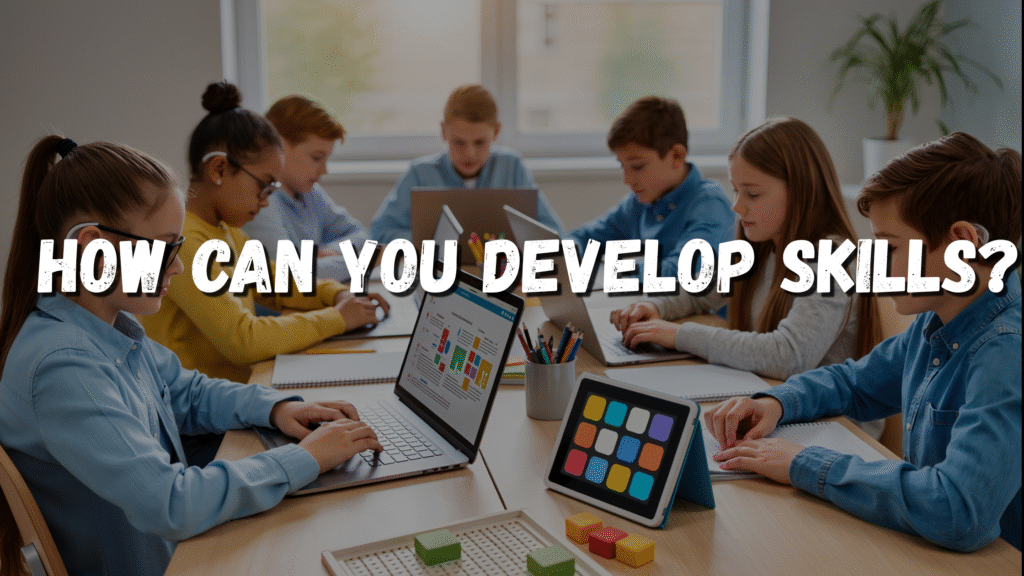
It is a long journey to develop the essential 21st-century skills through deliberate actions, self-reflection, and consistent effort; practice is integrated into daily learning and life experience.
- Take a Self-Assessment:
Know your level first: The tool for skill assessment and reflection might help you to realize your strengths and weaknesses in critical thinking, communication, leadership, and other skills.
- Create a personal development plan:
Using the assessment results, identify clear, achievable goals. Now, take each skill and break it down into small steps; in other words, explain in writing how you are going to reach each step of your ultimate goal with time.
- Request Feedback:
Get constructive feedback from your mentors, teachers, friends, or colleagues. Honest feedback is an eye-opener; it shows you areas you haven’t considered and helps you grow through different perspectives.
- Engage Skills in Daily Life:
Classrooms strengthen these skills through hands-on activities like group work, presentations, and online or volunteer learning. Theoretically, regular practice begets confidence and competence.
- Measure Success Often:
Follow up on your progress each month using a journal, checklist, or digital dashboard. Keeping track of small improvements keeps you motivated and brings significant progress over time.
Final Thoughts!
In today’s rapidly changing world, knowledge acquired in school alone is not enough to succeed. Some of the most essential skills in the 21st century include critical thinking, communication, adaptability, emotional intelligence, and leadership. By developing such skills, the student can face the hurdles encountered in everyday life.
Students, with proper guidance and a supportive environment, can always unlock their potential. The move towards consulting the best coaching institute in Dehradun would therefore prove helpful in this matter, making things easier for these students. They would be provided with the necessary support, and in this way, not only would they be in a position to clear their exams, but they would also look towards a bright future.
Frequently Asked Questions!
Future-ready skills are those that will be in high demand in the labor market and will help upgrade the company, the individual, and the entire country.
Future-ready skills are vital for finding a job and for career progression. Also, they make your kid a nice man.
Certainly, the main future-ready skills, along with technical skills, are communication, resilience, leadership, and several others.
Teachers educating young children can help their students develop future-ready skills by encouraging them to engage in co-curricular activities, pursue self-development, and be emotionally aware.
If one is disciplined and committed, every future-ready skill can be taught.





Leave a Reply